Monday, 23 March 2009

READ WELLS TOWER

Of all the writers featured on The Roving Editor, Wells Tower is the name that attracts most visitors to the blog, thanks to a brief post back in November. This augurs well for the success of his debut collection, Everything Ravaged, Everything Burned, which is shortly to be published on both sides of the Atlantic.

If I were asked to identify the qualities in Wells Tower's writing that make reading these stories such a rewarding experience, I would say that what impresses me most is the depth of his characterisation and the freshness of his language. The essence of good short story writing is economy, and in the same way that Picasso could conjure life from the simplest of lines, Tower has the gift of creating flesh and blood people out of a handful of words.

And what well-chosen words they are. Take this pen-picture of the narrator's father, abandoned by his much younger lover, in 'Executors of Important Energies': 'My father felt astonished in his grief -- pushing fifty, the silver tufts bursting from his ears, to find his heart broken for the first time in his life. That was the one time he tried hard to be my friend. He had me over on weekends. He'd tell me love was like the chicken pox, a thing to be got through early because it could really kill you in your later years.'

This quote also hints at a trait shared by many of Tower's protagonists: a sense of humour and self-knowledge in the face of adversity. In one of the best stories in the book, the carnival-set 'On the Show', there is a rare moment of tenderness between the new attendant on a ride called the Pirate Ship and one of his customers, a blind woman: 'The ride ends, and Jeff goes to her and helps her down the platform. She is warm against him, and cannot stop laughing. "Thank you, thanks very much," she says, and Jeff Park feels glad to have found work on the Pirate, a machine that draws joy out of people as simply as a derrick draws oil from dirt.'

Indeed, there is a strong case to be made for Tower as a comic writer, for all the bleakness of the lives and landscapes he depicts. The comedy is there in the grotesque tableau of a man obliged to void his dog's bladder using a kind of Heimlich manoeuvre ('Retreat'); in the uneasy conversation between a violent man and his ex-wife's hippy lover, suddenly thrown together on a road-trip ('Down Through the Valley'); and, most flamboyantly of all, in the Pythonesque but ultimately poignant title story, an everyday tale of marauding Vikings who speak in modern American: 'A hydra flew in last night and ran off with Rolf Hierdal's sheep. We can't be putting up with this shit. It comes down to pride, is what it comes down to.'

Uncomfortable encounters and strained relationships are something of a Tower speciality, as are sudden explosions of violence. All of these elements are present in 'On the Show', which for me is the key story in the collection. Its fairground setting seems a perfect metaphor for the desire for thrills and transcendence that drives the characters in the stories, a desire that the gaudy rides can only satisfy fleetingly before disappointment takes hold again. Jeff Park has an assignation with a girl with a fondness for phosphorescent candy whom he meets on the Pirate Ship. She doesn't show. Eventually he tracks her down: 'He goes to her quickly, puts his hand on her shoulder, and pulls her toward him, hard enough that her head jerks back. People turn. Her jaw hangs wide and pretty, but the light in her mouth has gone out.'

I could go on, but the main point of this blog is to direct readers to the work itself. You can whet your appetite for the book by sampling two of the stories online: 'Everything Ravaged, Everything Burned' and 'Wild America'. You won't be disappointed.

Tuesday, 3 March 2009

THE ESSENCE OF ADAPTATION

The Guardian Review has an excellent, thought-provoking essay by Salman Rushdie on the subject of literary adaptation. Rushdie's contention is that the aim of any such enterprise – whether it is the translation of a poem or the transfer of a novel to film – should be to capture the essence of the original work. Slavish "fidelity" to the source material is both misguided and futile, hence his apparent respect for what he describes as the "creatively savage" approach taken by Spike Jonze and Charlie Kaufman's 2002 film.

However Rushdie also wishes to examine the notion of adaptation in its broadest sense. To do so, he says, "is to see that all the meanings of the word deal with the question of what is essential – in a work adapted to another form, in an individual adapting to a new home, in a society adapting to a new age. What do you preserve? What do you jettison? What is changeable, and where must you draw the line? The questions are always the same, and the way we answer them determines the quality of the adaptation, of the book, the poem, or of our own lives."

In the course of the article, Rushdie reveals that he is working on a screenplay of Midnight's Children, which is to be directed by Deepa Mehta. It will be fascinating to hear his further thoughts on the adaptation process once this project comes to fruition.

THE TALENTED MR ROSSET

Barney Rosset, legendary New York publisher, is the subject of Obscene, a documentary film released in the UK this week. View the trailer here, and read a New York Times feature here.

Though Rosset relinquished Grove Press some years ago, he is still Editor in Chief of the Evergreen Review, which made its first appearance in 1957. The magazine now publishes most of its content online, and there are several short stories by new writers in the current issue.

Friday, 6 February 2009

INTRUDERS IN THE DUST

The latest New Yorker fiction offering is from a veteran of the magazine, Steven Millhauser. 'The Invasion from Outer Space' is a witty exploration of what occurs when our most deep-seated fears are made manifest, when events of which we have dreamed or which we have only experienced through books and films become reality.

The imagery of 9/11 was so disturbingly familiar from popular culture that it has become difficult to revisit the cliches of the disaster movie, for example, without evoking that day. Millhauser turns this phenomenon on its head by taking as his subject a version of The War of the Worlds in which the long-dreaded alien encounter turns out to be a bit of an anti-climax. The narrator wants 'terror and ecstacy', but all he gets is a coating of yellow dust.

It's a tribute to the author's sensitivity and sense of humour that the story itself doesn't disappoint, and, unlike the extraterrestrial visitation, at just over 1500 words it doesn't outstay its welcome either.

Steven Millhauser's most recent collection is called Dangerous Laughter.

Friday, 30 January 2009

VENICE OR LAS VEGAS

A welcome online fiction showcase has been launched by Harper Perennial, as reported by 3:AM. Curated by Cal Morgan, Fifty-Two Stories will publish new work every week this year by both established and emerging writers of the form.

The series got off to an auspicious start with its first offering. Simon Van Booy's 'The Missing Statues' has a classic storytelling set-up: two strangers meet and fall into conversation about events from another time and place that are somehow connected to the here and now. One of them tries to comfort the other, saying: “I simply want to know why a missing statue has reduced a young American businessman to tears.”

Like the statues of the title, everything in the story is at one remove from reality: the narrator speaks of Venice, but only as it is reimagined in Las Vegas. His tale involves a man who pretends to be an Italian gondolier, mimes the voice of Enrico Caruso and recognises his own daughter in a woman whose small child he befriends.

British-born Van Booy's writing is highly coloured and romantic, but manages to skirt sentimentality. There is real feeling behind these facades, these masks and wishful imaginings.

The story is taken from a forthcoming collection called Love Begins in Winter, which is published in the US in May, and in the UK in November. It should be worth investigating, as should the rest of Cal Morgan's choices for Fifty-Two Stories this year.

Tuesday, 27 January 2009

F SCOTT HOT IN HOLLYWOOD

The Roving Editor started life blogging about the links between literature and movies under the title The Word on Film. It seems appropriate to return to this relatively unexplored zone via Zoetrope All-Story, the literary magazine published by Francis Ford Coppola.

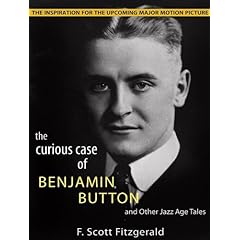
This time last year we knew of two forthcoming films based on F Scott Fitzgerald stories, The Curious Case of Benjamin Buttton and Pat Hobby. Here is screenwriter Eric Roth in the current issue of Zoetrope on adapting Benjamin Button. The magazine also carries the story itself, though it's not available to read online. It was originally published in the collection Tales of the Jazz Age.

Meanwhile the only update on Pat Hobby is that it is being lined up for production this year; the film company's synopsis reads: 'Fitzgerald’s beloved hack fights for a writer’s buck in the Hollywood studio system.'

The author himself was no stranger to penury, of course, but these days he'd have found it a lot less difficult to make a beautiful dollar in Tinseltown: as well as the aforementioned adaptations, there is also news of yet another remake of The Great Gatsby, this time by Baz Luhrmann. However Variety has this cautionary tale of the mixed artistic and box-office fortunes of F Scott on screen.

Francis Coppola should be watching all of this with especial interest: he wrote the screenplay for the faithful but unloved 1974 adaptation of Gatsby.

Friday, 9 January 2009

ONE TO WATCH IN 2009

Among a handful of literary names on the Observer's 'hotlist' for 2009 is the young New Zealander Eleanor Catton. From what I have seen of her work, the interest is entirely justified. 'The Outing' has the mingled humour and menace of a Hitchcock movie in miniature, while 'Necropolis' is a beautifully observed depiction of a dead-end job. It's no surprise to see that the author is a fan of Muriel Spark.

'The Outing' has apparently been reworked as a scene in Catton's debut novel The Rehearsal. According to the Observer this is due to be published by Granta in the UK in July, though this edition is not currently listed on Amazon, and the publisher does not appear to have a website at present. More details when we have them.